El carrito esta vacío

Why Misunderstanding IES vs. Integrating Sphere Tests Annoyed Our Client Today (And How to Fix It)
Many clients often misunderstand the difference between IES goniophotometer testing and integrating sphere testing for LED lighting products. This guide simply explains their core functions, testing principles, accuracy differences, and critical roles in LM-79, Energy Star, and DLC certifications, helping you clarify professional photometric testing confusion and meet global lighting compliance standards.
Why Clients Confuse IES Test and Integrating Sphere Test
Earlier today, our client Ms. Lucero was understandably frustrated. A miscommunication around "testing" left her confused about why we were running two different procedures. She asked a fair question: If both measure light, why do we need both?
We realized we hadn't explained it clearly enough. If you’ve ever found yourself confused by the difference between an IES Test (Goniophotometer Test) and an Integrating Sphere Test, you are not alone.
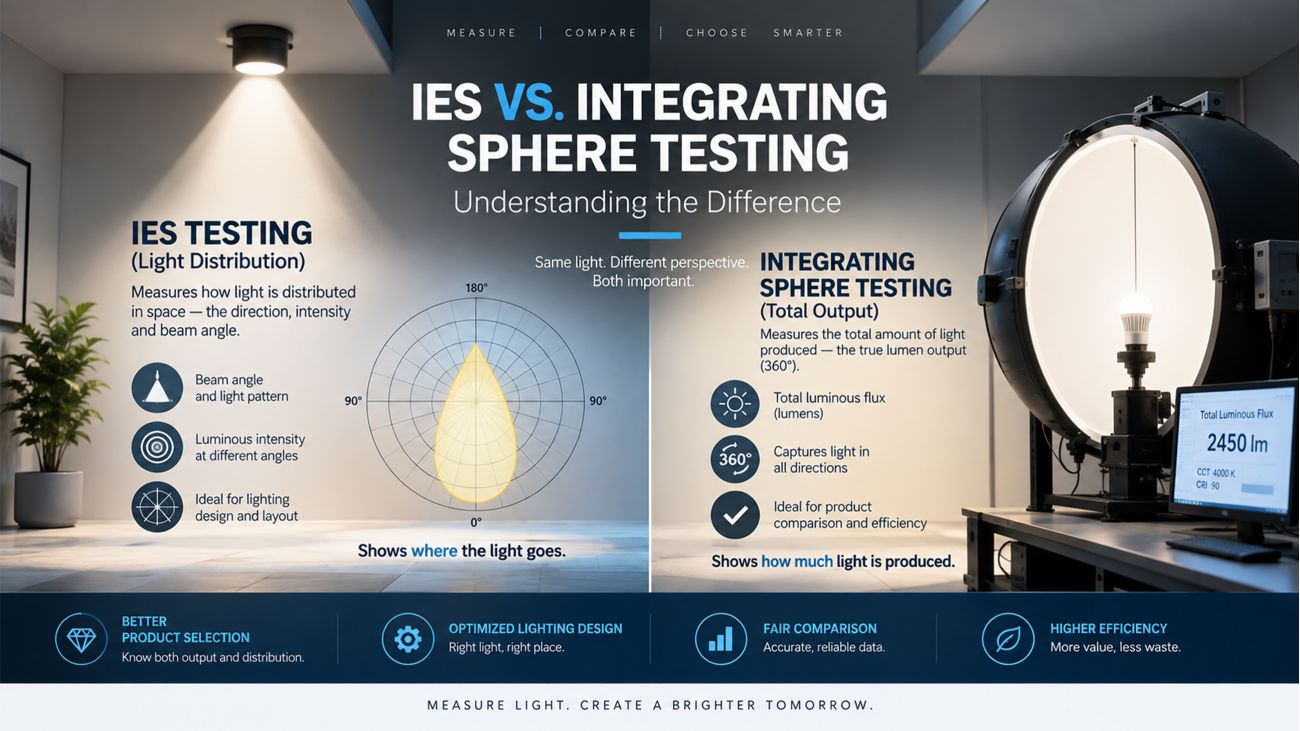
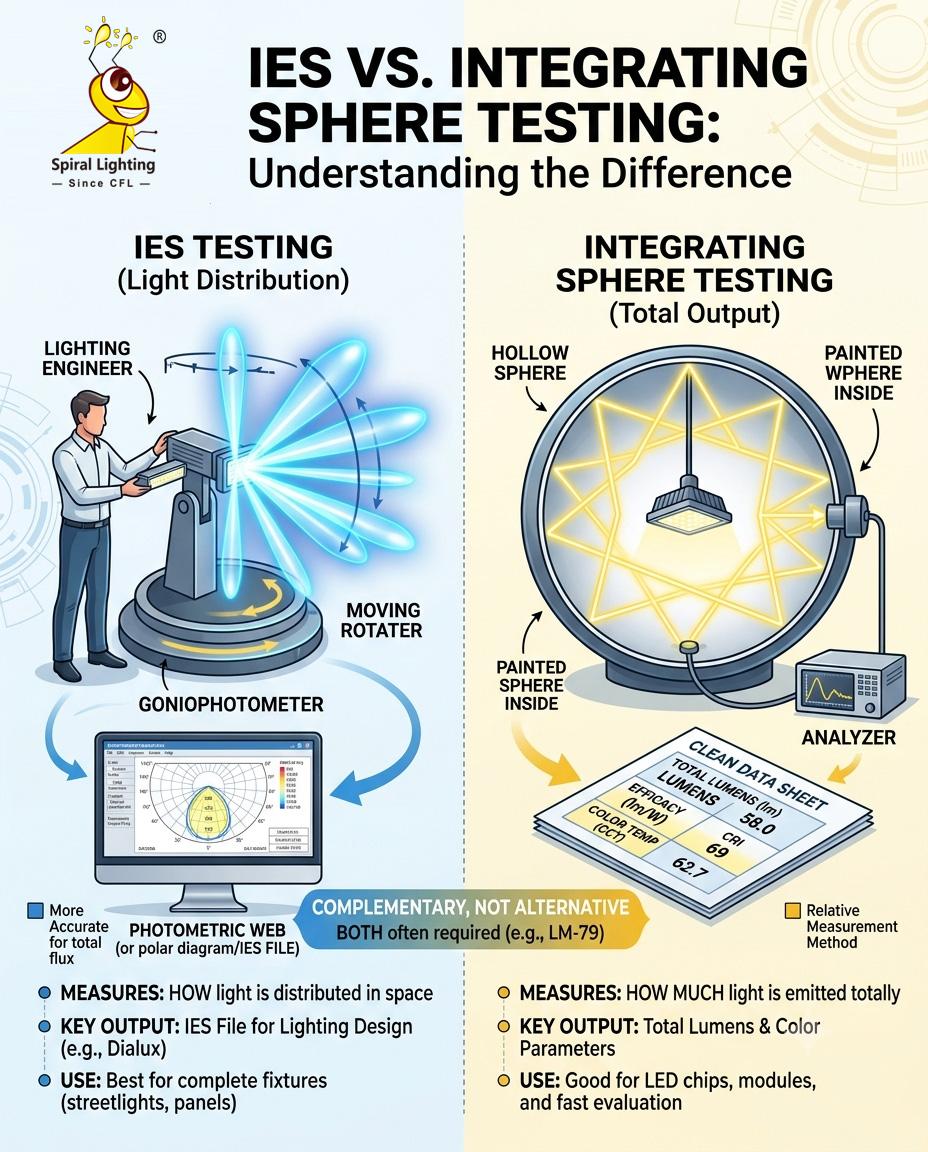
Here is the simple breakdown we shared with Ms. Lucero to clear the air: An IES test measures HOW a fixture distributes light in a space, while an Integrating Sphere test measures HOW MUCH total light it emits.
They are entirely different dimensions of LED evaluation. Here is how they stack up:
The Core Differences at a Glance:
IES Test (Light Distribution Test)
The Purpose: Measures light intensity in every direction across a 3D space to see exactly how the beam spreads.
The Method: Uses a Goniophotometer where the fixture rotates on a goniometer to capture angles.
The Output: Generates an .IES file (photometric data), the essential blueprint needed for lighting design software like Dialux.
Accuracy:Offers higher absolute accuracy for total luminous flux because it avoids the self-absorption errors common in spheres.
Integrating Sphere Test (Total Luminous Flux)
The Purpose: Measures total light output (lumens), efficacy, and critical color properties (CCT, CRI, Ra).
The Method: Places the light source inside a hollow sphere coated with highly reflective material to collect all combined light.
The Output: Provides a precise data sheet of Total Lumens (lm), Efficacy (lm/W), Color Temperature (CCT), and Color Rendering Index (CRI).
Accuracy: A relative measurement method calibrated against a standard lamp. It's incredibly fast but slightly less precise for complex fixtures compared to a goniophotometer.
The Relationship: It’s a Tag Team, Not an Either/Or
In global compliance standards like LM-79 (the North American standard for solid-state lighting), you actually need both. They complement each other rather than replace one another:
- Integrating Sphereis your go-to for rapid testing of LED chips, modules, or initial fixture color quality.
- IES Testing is non-negotiable for finished fixtures (like streetlights, downlights, or panels) to prove performance for certifications like Energy Star or DLC.
The Takeaway
Miscommunications happen, but we believe in transparency and education. By the end of our call, Ms. Lucero didn't just understand the process—she felt confident that her product was getting the exact, rigorous testing it required for market success.
Have you ever run into confusion explaining photometric reports to your clients? Let's discuss in the comments below!
Mobile Phone
WhatsApp:+86 19818738919
Email Address
billy@spiral-lighting.com
Na naslovnicuSljedeća objava