
Panier vide

If you don’t know this value in LED lighting, you risk visible defects in your project
SDCM, also known as MacAdam ellipse, is a vital quality parameter to evaluate color consistency of lighting products. A lower SDCM value means better color stability and higher light quality. It is widely applied in offices, retail, architecture, outdoor and industrial lighting, and plays an important role in improving overall project quality and user experience.
SDCM Value Ranges and Application Scenarios
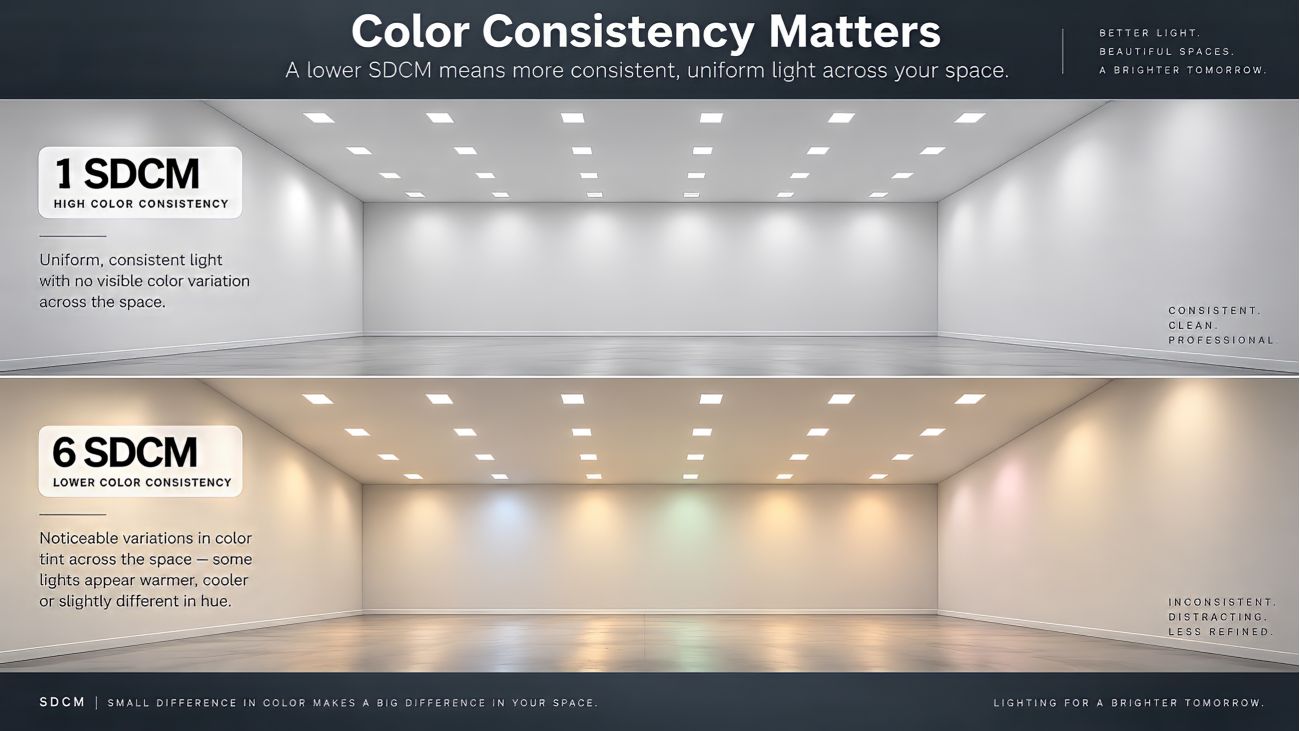
In our industry, there’s a lot of talk about efficiency, smart lighting, lighting control, or IP ratings –but one of the most important quality parameters is almost always overlooked: SDCM / MacAdam – the key to color consistency, light quality, and professional lighting design. Even a single step of difference determines whether a room appears uniform, high-quality, and architecturally clean –or whether color deviations, inconsistencies, and quality issues become immediately noticeable.
What does SDCM actually mean?
SDCM (MacAdam) describes how far the actual light color is allowed to deviate from the nominal color temperature.
A crucial factor in premium lighting, planning reliability, TCO, and overall project quality.
The lower the SDCM value, the better: more color stability, higher quality, lower risk.
Typical ranges in practice
≤ 3 SDCM → Professional indoor lighting, office, retail, hospitality
1–2 SDCM → High-end lighting, architecture, design & premium projects
4–5 SDCM → Outdoor areas, industrial, robust environments
Why SDCM is critical for project success
Homogeneous lighting without visible color shifts
Planning reliability for large quantities & sensitive applications
Quality assurance for professional lighting solutions
Relevant factor in EN 12464-1, architecture, retail & office projects
Reduces complaints, increases project quality & customer satisfaction Conclusion SDCM is the invisible quality parameter that determines color stability, project perception, and professional lighting quality — and therefore plays a decisive role in the success or failure of modern lighting projects.
If you want more perspectives on light quality, planning reliability, and what really makes the difference in projects – feel free to follow and join the discussion.
Na naslovnicuSljedeća objava