

Why are almost all LED chips "Blue"?
Have you ever wondered why mainstream white LED lighting relies on blue chips? This article explains the physical characteristics of blue light, technical limitations of green and red LEDs, and the economic benefits of mass production, revealing why blue chips become the core base of modern lighting.
The Physical Principle Behind Blue LED Chips Technical Defects: The Industry Green Gap Scale Production and Economic Advantages of Blue LEDs
Ever noticed that beneath the surface of almost every LED, there’s a blue chip staring back at you? Whether it's for home lighting, your smartphone screen, or car headlights, Blue Light is the undisputed king of the industry.
I’ve put together a quick deep dive into why Red and Green chips aren’t the "base" of modern lighting. It boils down to physics, manufacturing, and pure economics.
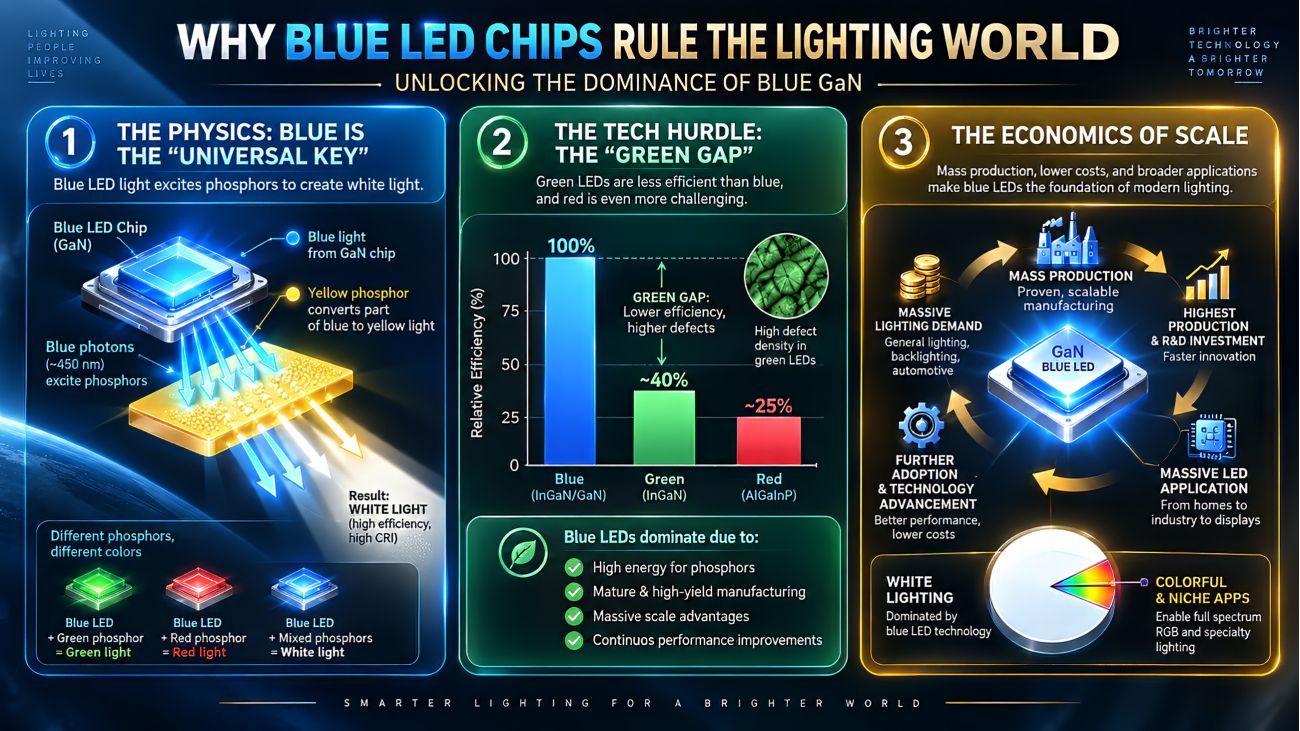
1.The Physics: Blue is the "Universal Key"
To get "White Light", we need a mix of wavelengths. Blue light has short wavelengths and high photon energy, making it perfect for "exciting phosphors".
The Recipe: Blue Chip + Yellow Phosphor = White Light.
Blue can easily be converted into Green or Red via phosphors, but the reverse is physically impossible (Red light doesn't have enough energy to "create" Blue). This makes Blue the only viable foundation for general illumination.
2.The Tech Hurdle: The "Green Gap"
Most LEDs use Gallium Nitride (GaN). By adjusting the Indium (In) content, we change the color:
Blue: Low Indium, perfect crystal lattice, high efficiency, and high yield.
Green: High Indium causes "lattice mismatch," leading to massive defects and lower brightness.
Red: Usually requires different materials (AlGaInP) which don't handle heat as well as GaN.
In the industry, we call this the "Green Gap"—Green LEDs are significantly less efficient than Blue ones at the same power level.
3.The Power of Scale
Because the global lighting market is massive, the production of Blue LEDs has reached an incredible Economy of Scale.
Massive Investment: Decades of R&D have optimized Blue GaN production. Cost Advantage: High yields mean Blue chips are incredibly cheap (often just cents per unit).
Green and Red chips remain niche players (used in displays or stage lighting), meaning their costs stay high while Blue continues to get better and cheaper.
Summary in One Sentence:
We use Blue because it’s the most energy-efficient "starter" light, the easiest to manufacture at high quality, and the most cost-effective due to massive global demand.
Quick Poll for the community:
Did you know that white LEDs don't actually "emit" white light directly?
A: Yes! Blue chip + Yellow phosphor is the gold standard.
B: I had a vague idea, but didn't know the "Green Gap" physics.
C: First time hearing this! I thought they just glowed white.
Let us discuss the comments!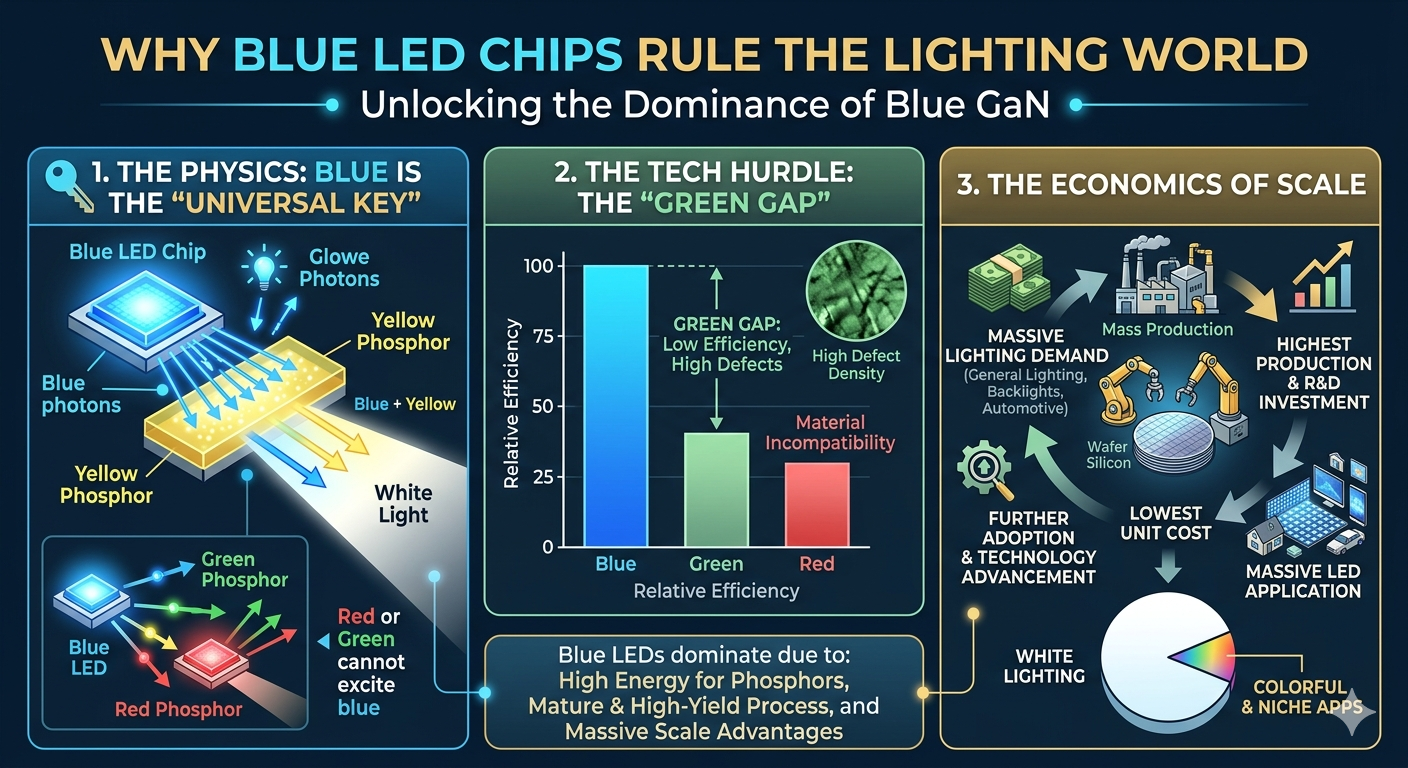
Na naslovnicuNext article