

How Top Procurement Managers Use UGR to Win Premium Projects
UGR (Unified Glare Rating) is the core international standard for evaluating lighting comfort and anti-glare performance. Widely required in premium offices, schools, hospitals and commercial projects, UGR values directly determine visual comfort, space grade and project acceptance results. Lower UGR ratings deliver healthier vision, higher-end lighting effects and more reliable project performance, helping buyers and designers avoid glare-related complaints and renovation risks.
UGR Value Levels and Practical Lighting Applications
Have you noticed it too?
Lately, more and more tender documents for premium offices, schools, and commercial projects across Latin America are explicitly demanding UGR<19, or even UGR<16.
If you are a Procurement Manager or Product Manager, understanding this metric isn’t just about compliance—it’s your secret weapon for winning high-margin projects and avoiding costly post-installation complaints.
Let’s break down what UGR actually means for your bottom line.
What is UGR, and Why Does It Matter?
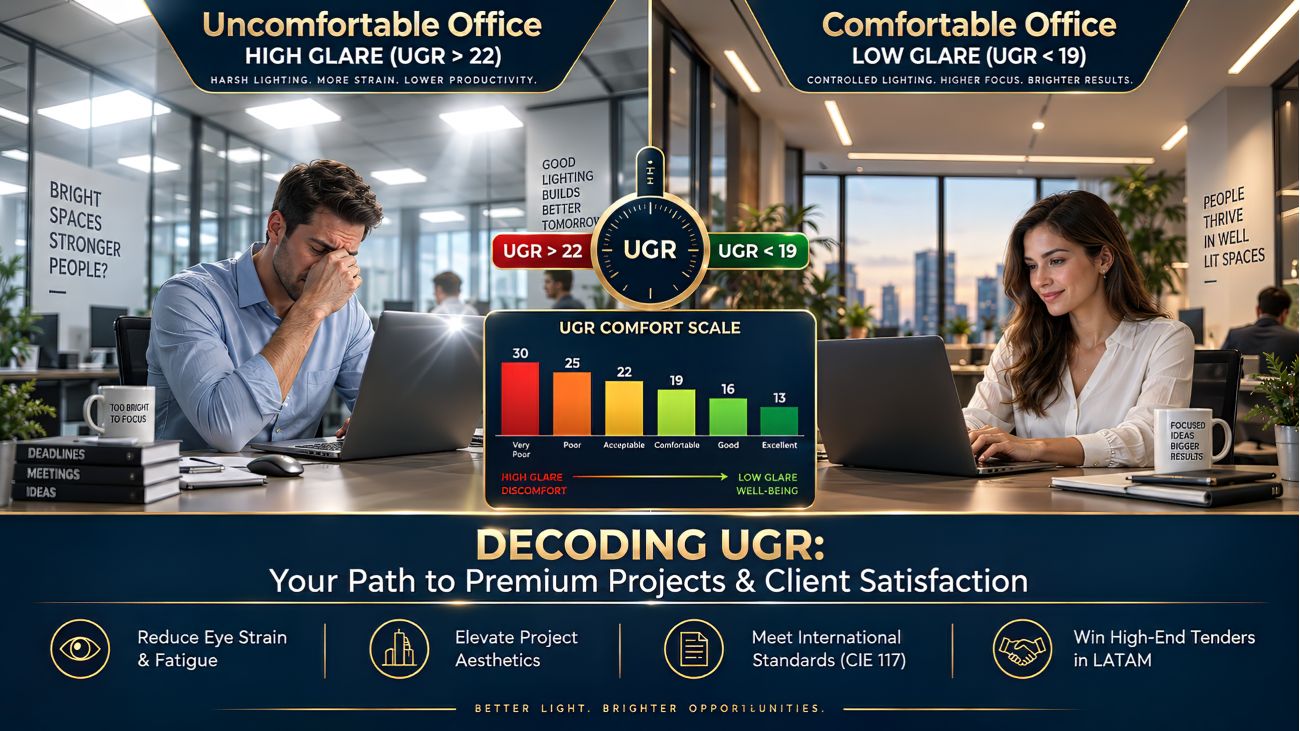
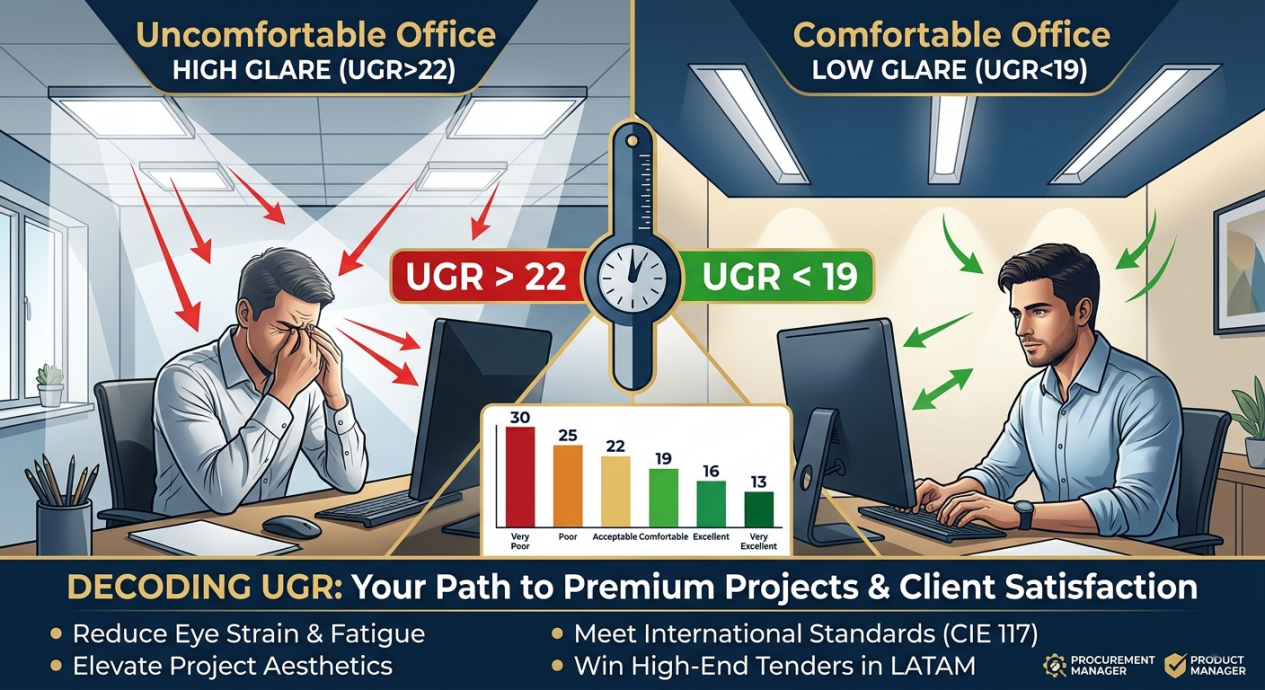
Glare is that uncomfortable, piercing sensation when light is too bright or poorly directed. UGR (Unified Glare Rating) is the international standard (CIE 117) used to quantify this discomfort, ranking from 10 to 30.
UGR < 19: The standard baseline for acceptable office comfort.
UGR < 16: Premium comfort (ideal for schools, hospitals, and high-end tech offices).
UGR < 13: Near-perfect visual comfort.
The Golden Rule: The lower the UGR, the happier the end-user, and the higher the perceived value of the space.
The Hidden Risks of Ignoring Glare
When a project cuts corners on anti-glare compliance, the consequences show up immediately:
- Eye Strain & Fatigue: Drastically reduces productivity in workspaces.
- Cheap Aesthetic: Even expensive fit-outs look low-end if the light sources are blinding.
- Failed Inspections: Missing the UGR targets specified in the design phase can lead to rejected handovers.
Achieving a low UGR requires smart engineering—think deep-recessed structures, precise optical lenses, micro-prismatic diffusers, or anti-glare louvers. While these features might slightly affect the initial fixture cost, they save thousands in potential retrofitting and customer dissatisfaction.
Quick Reference: Market Standards (CIE)
Premium Offices & Design Studios: UGR ≤ 19 (Recommended ≤ 16)
Classrooms & Lecture Halls: UGR ≤ 16
Hospitals & Wards: UGR ≤ 16
High-End Retail & Showrooms: UGR ≤ 19
Let’s Discuss!
As professionals driving the lighting industry forward, how is your team tackling the glare challenge?
Which of these is your biggest priority right now?
- A) Knowing how to accurately audit and read factory UGR test reports.
- B) Balancing the cost-to-performance ratio of advanced anti-glare optics.
- C) Matching the right UGR thresholds to specific local project regulations.
Drop your thoughts or your recent project experiences in the comments below!
Na naslovnicuSljedeća objava