

Why 24W Doesn't Always Mean the Same Brightness
Two LED fixtures with identical wattage may deliver totally different brightness. Wattage shows power consumption only, while lumens stands for light output and lm/W indicates lighting efficiency. This article helps buyers correctly read core LED parameters for fair product evaluation.
Why Two LED Lights With Same Wattage Can Have Different Brightness
When comparing LED lighting products, you may notice something interesting:
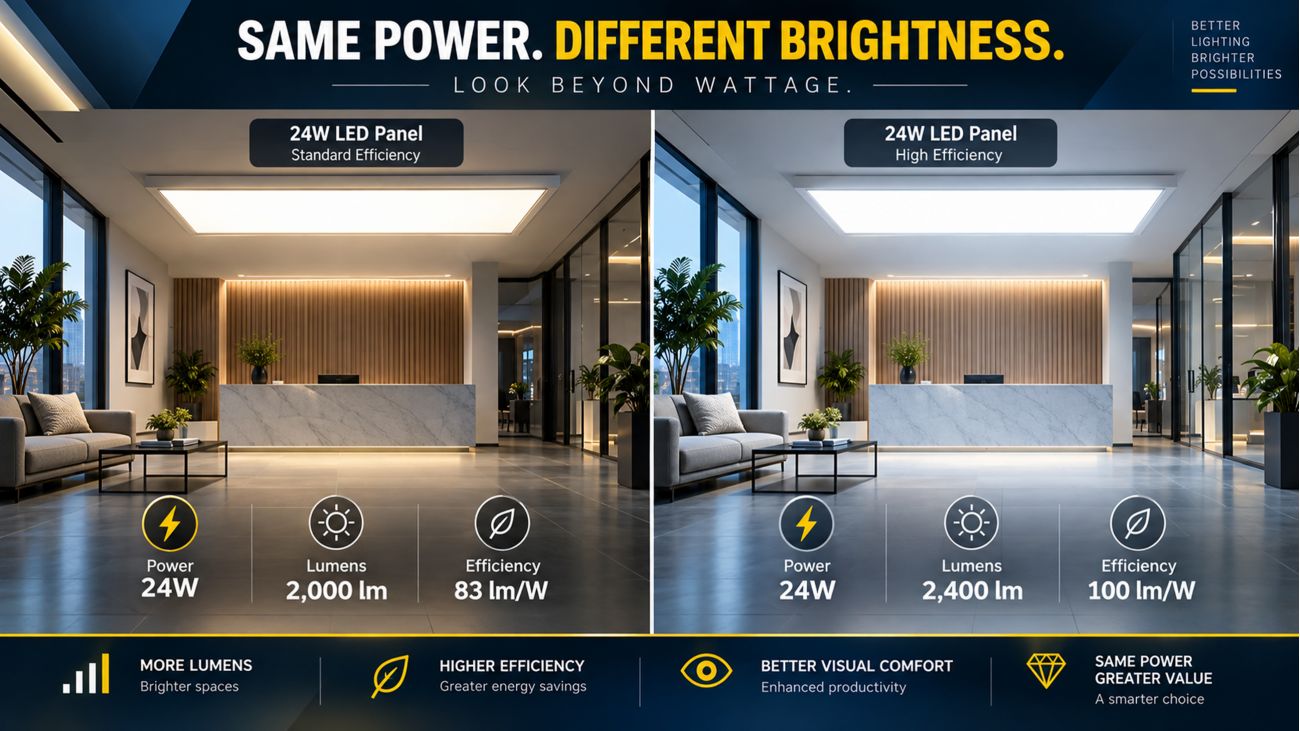
Two 24W LED lights don't always produce the same amount of light. Why?
Because Wattage tells you power consumption, not light output.
There are three important parameters to look at:
1.Wattage (W)
It tells you how much electrical power the product consumes.
For example:
Product A: 24W
Product B: 24W
Both consume similar power, but their light output can be different.
2.Lumens (lm)
Lumens measure the amount of visible light produced.
For example:
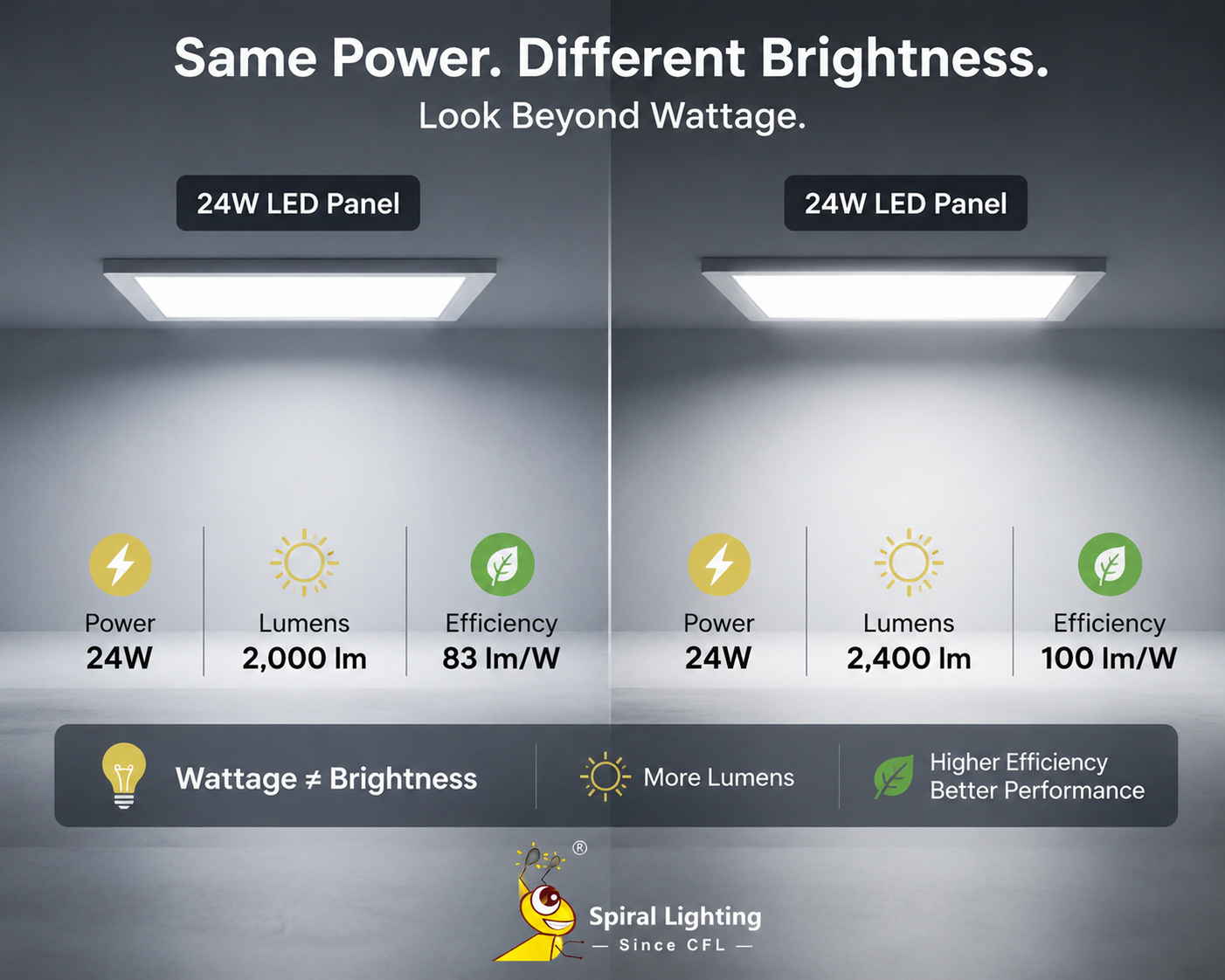
24W → 2,000 lm
24W → 2,400 lm
Both are 24W, but the second product produces more light.
3.Lumens per Watt (lm/W)
This tells us how efficiently a product converts electrical power into light.
2,000 lm ÷ 24W = 83 lm/W
2,400 lm ÷ 24W = 100 lm/W
So the second product has higher luminous efficacy.
Of course, final performance depends on more than just the LED chip. Driver efficiency, optical design, diffuser/light guide plate, and thermal management can all influence the performance of the finished luminaire.
A simple rule for LED buyers:
Wattage → Power consumption
Lumens → Light output
lm/W → Lighting efficiency
So the next time you compare two 24W LED panels, don't look at wattage alone.
Ask:
How many lumens does it produce?
What is its lm/W?
Because in LED lighting, 24W doesn't always mean the same brightness.
Mobile Phone
WhatsApp:+86 19818738919
Email Address
billy@spiral-lighting.com
To the main pageNext article